There are many reasons why you might want to buy or custom design a coloured gemstone ring:
- Gemstone Engagement Ring: You’re looking to create a special, unique engagement ring that’s a bit different from the traditional diamond ring.
- Birthstone Ring: You’re looking for a special piece of jewellery to celebrate someone special, such as a family member, birth of a child, your partner, etc.
- Celebration Ring: Purchasing a special piece of jewellery is a lovely way to mark a special occasion, such as a wedding, anniversary, graduation, or milestone.
- Mother’s Ring: You’re looking to create a bespoke ring holding the birthstones of your children.
- Remembrance Ring: Creating or buying a special ring to remember someone close to you
- “Just because” Ring: Buying a ring just because you want to or you can!
Whatever your reason, if you’re buying for yourself or as a gift, finding a beautiful gemstone ring can be a tricky and confusing process. Unlike diamonds, there’s not really a worldwide guide on what is ‘ideal’ in terms of cut or colour. Plus, there are a large number of gemstone varieties that can be used in rings, each with their own special nuances and qualities.
So, how do you go about buying or creating a gemstone ring?
Step 1: Determine your budget (time and money)
Your budget will determine your approach to the following steps in this guide, so it’s best to decide this upfront. Gemstone rings can vary dramatically in price, from a few hundred to hundreds of thousands, depending on the stone, side stones, metal, design, and jeweller.
Decide how much you would be willing to spend on a whole ring, on a stone on its own, and on a setting.
Finding the perfect ring can also be time consuming, so decide how much time you want to give over to this project. If you’re time poor, your best bet may be to skip the custom route and go straight to a jeweller (armed with the tips and suggestions in this article).
It is difficult to recommend what the ‘ideal’ budget is for a ring without knowing specifics. It is possible to create a beautiful ring for less than €1,500. For something spectacular, you could be talking €3000, €5000, €10,000, or much, much more!
Step 2: Decide custom vs. already made vs. something in between!
Deciding to go custom-made or purchasing an already finished ring is the second decision you’ll need to make, and it depends on:
- Do you want something bespoke to you? (go custom)
- Are you short on time? (go already made)
- Do you want control over the stones selected for the ring and the setting itself? (go custom)
- Are you happy to let someone else take the hassle of finding stones and choosing design elements? (go already made)
Budget is also another consideration. There are some stunning rings out there that carry a premium due to the designer/jeweller who created them—similar to how designer clothes are priced. Similarly, to go down the custom route may be costly due to the labour and bespoke element. However, depending on your setting and stone, it is possible to get a custom-made ring cheaper than if you were to buy it already made.
Going custom could mean sourcing and purchasing the gemstone and having a jeweller create a ring setting for you. The jeweller will work with you to work out your design through sketches or computer-aided design (CAD); then they will make the ring for you either by hand or by using CAD to create a mold. The major downside of this option is that you are not able to try on the final product without first purchasing it, with many jewellers having a no-refund policy on custom-made projects and requiring deposits upfront.
Deciding on purchasing an already made ring takes away some complexities of sourcing the stone and creating a design, and this avenue comes with the added bonus of being able to see and try on the ring without purchasing it.
The third option is to go for something semi-custom. This is where you would purchase the stone and the setting separately. A setting without a centre stone is called a ‘semi-mount’. You can buy a second-hand one (usually where someone has removed the centre stone already to sell separately or to move to a different setting), or you can buy a new semi-mount from a jeweller or online (try eBay or Etsy).
Step 3: Picking a gemstone
Now the fun part begins! Decide what gemstone(s) you want to feature in your ring.
The top three coloured gemstones are:
- Sapphires
- Rubies
- Emeralds
However, there are so many other choices. Sapphires come in many colours (in fact rubies are red sapphires!) and are an excellent choice for a ring as they are very durable and rank after diamonds on the Mohs scale.
You may choose to select a gem based on the birthstone list. This is a list of gems matched to the months of the year, which makes for a great way to add some sentimental meaning behind your gem choice, especially if making a mother’s ring, a birthstone ring, or a celebration ring.
The list of birthstones by month are below:
| Month | Gemstone |
| January | Garnet |
| February | Amethyst |
| March | Aquamarine or Bloodstone |
| April | Diamond |
| May | Emerald |
| June | Alexandrite, Moonstone, or Pearl |
| July | Ruby |
| August | Peridot, Spinel, or Sardonyx |
| September | Sapphire |
| October | Tourmaline or Opal |
| November | Topaz or Citrine |
| December | Zircon, Tanzanite, or Turquoise |
Before deciding which stone to go with, read up on the durability of the stone, particularly where it ranks on the Mohs scale, which is a measure of how hard a stone is. Diamond rank at 10, followed by sapphires at 9. For a ring, I wouldn’t recommend going below a 6 or 7 on the scale, especially for a ring as the gem may become damaged from knocks while you’re wearing it.
How often you plan to wear the ring should also play a part in your gemstone selection. An engagement ring, for example, would usually be worn every day, and so a sapphire or a spinel would be a better choice than an aquamarine or an emerald.
Step 4: Select the perfect stone
Now that you’ve decided what gemstone to go with, the next step is to pick the actual gemstone that is going into the ring.
Here is where it can get tricky. There are plenty of reputable gemstone sellers online, however for some gems, no matter how many photos or videos you view, it may look very different when in your hand. So if purchasing online, it is prudent to read the return policy.
The important thing to remember when selecting which stone to buy is that colour is the most important element of the stone. And as to which colour is best? That’s entirely down to your own preference! Some people, for example, prefer a cornflower silky blue in a sapphire, while others love the midnight deeper blue tones (think Princess Diana’s/Duchess of Cambridge’s ring). View a few different stones if you can to see which colour speaks to you most.
Differing from diamonds, the cut of a coloured stone is not the be-all and end-all. A ‘native cut’ stone is usually cut close to the mines and the stone is cut to maximise weight and the stone’s face-up size. A ‘precision cut’ stone is cut by specialist gem cutters to maximise the stone’s brilliance and colour.
Some pieces to watch out for when buying a gemstone are windows. These are areas in the middle of the stones which are colourless and see through. Some may be small and could be minimised when setting, while others are very noticeable. Buying a stone with a window is down to personal preference. Some may be bothered by seeing through the stone, while others may not notice it at all.
For a truly unique stone, you can have one custom cut, or buy from a cutter who specialises in fancy cuts, such as pixelated effects, concave cuts (think shooting stars inside the gem), carvings, and more.
Size is another factor to consider. If you want to go down the semi-mount route, you will need to buy a stone that will fit into the standard semi-mount sizes, such as 6x4mm, 7x5mm, 8x6mm, etc. Coloured stones are measured by carat similar to diamonds. However, the face-up size is more important in determining how big you want your ring, as gemstones differ in density and weight to each other and to diamonds, so a 2ct opal may look very different in size to a 2ct diamond!
Before buying your stone, view as many videos and photos as the vendor can offer, including different lighting sources, as stones can look very different indoors vs. outside in sunlight. Be sure to ask about any inclusions the stone may have, where they are located on the stone, and if they are visible. Also, ask if there are any inclusions that may make the gemstone more fragile, particularly any surface-reaching cracks—they may make your stone more susceptible to breaking if hit off a hard object or dropped.
Don’t get too caught up in non-eye visible inclusions, though, especially if they don’t compromise the integrity of the stone. Tiny chips around the girdle (outer edge of the stone) can be hidden by prongs, and you could get a bit of a deal on the stone. Remember once set you will be looking at the ring at arm’s length most of the time, not through a microscope!
Also check if any additional taxes or duties apply to your purchase. This will depend on if you’re buying from inside or outside the EU, if you’re buying an unset gem or a finished ring, and the value of the goods. This varies country by country.
When you do receive your stone, or if you’re viewing stones in person, make sure to view it under various different lighting sources. Balance it in between your fingers in your hand to get an idea of how it may look against your skin and how big/small the ring will be. Stones look much smaller in person than on screen as they’re usually magnified when photographed.

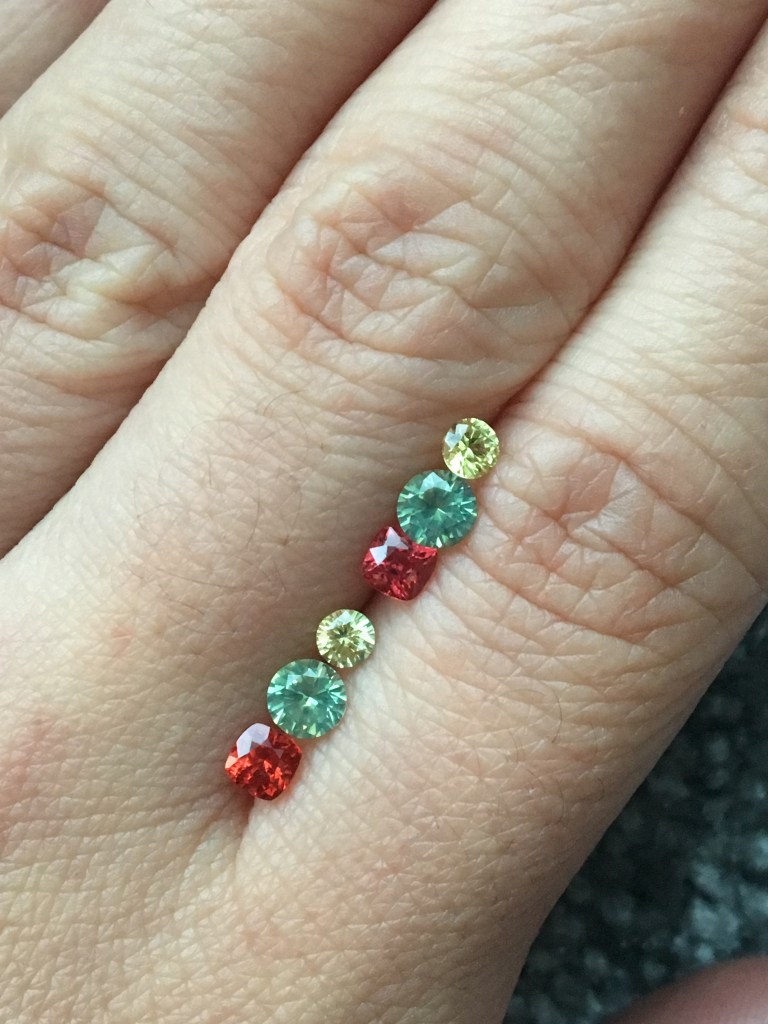
Step 5: If going custom: finding and working with a jeweller
Congratulations on selecting the perfect stone. Now the next step is to turn it into a ring!
If you’re going down the semi-mount route, take the stone to the jeweller and ask to see any stock settings/semi-mounts they may have, or a catalogue of any other settings they could order in. Place the stone into the semi-mount to see how it would look finished.
I would recommend choosing a jeweller who has an in-house bench which means they can set or create your ring in house without having to send it off to a third party.
For a bespoke, custom design, search for jewellers whose work matches the style you’re looking for. Instagram is a great source, as you can browse through the jeweller’s feed to see their past works. As custom work can be expensive, research the jeweller, read reviews, and Google search them to find any issues before commissioning any work.
Reach out to the jeweller with a photograph of your gem and a brief description of what you’re looking for. The jeweller can then give you an idea of how they work, timelines, and chat with you to flesh out your ideas.
If you have a clear idea of what you want in your ring, you may be able to use a versatile bench jeweller who can work your idea into CAD. Remember that copying another jeweller’s work is not allowed and unethical. However, you can draw inspiration from a few different rings to create something unique to you.
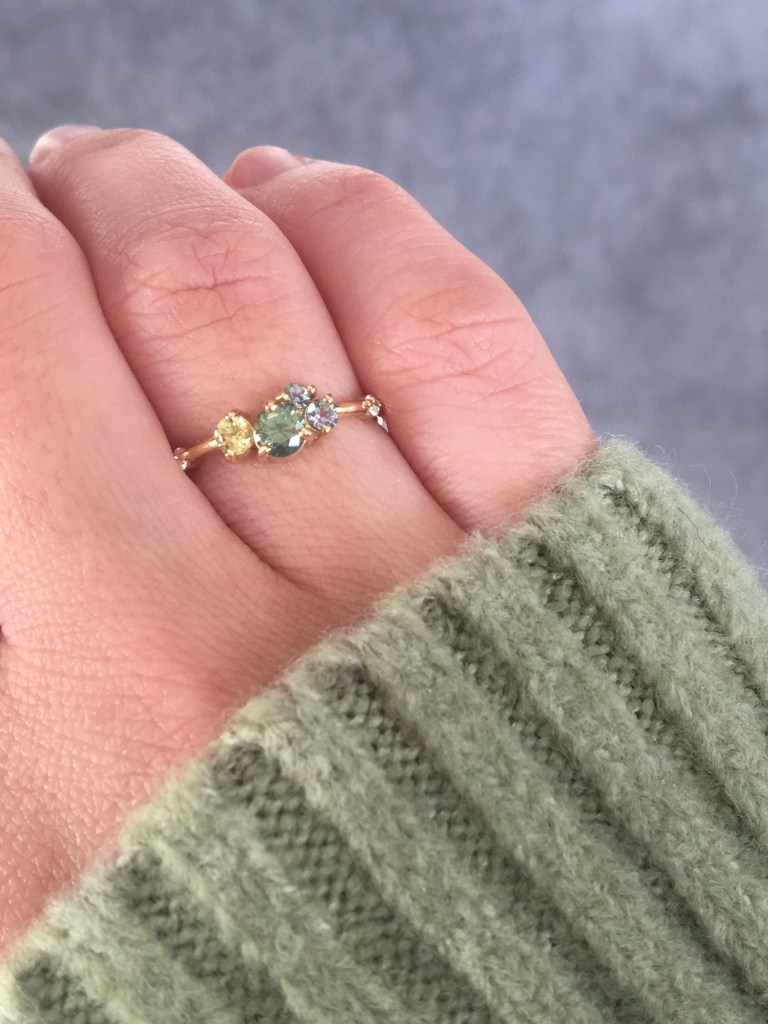
Then sit back and wait while the jeweller creates your special ring and enjoy the final product!
 Facet & Crown
[…] For some tips on how to commission a ring of your own, please read my guide to buying or designing a gemstone ring. […]
LikeLike